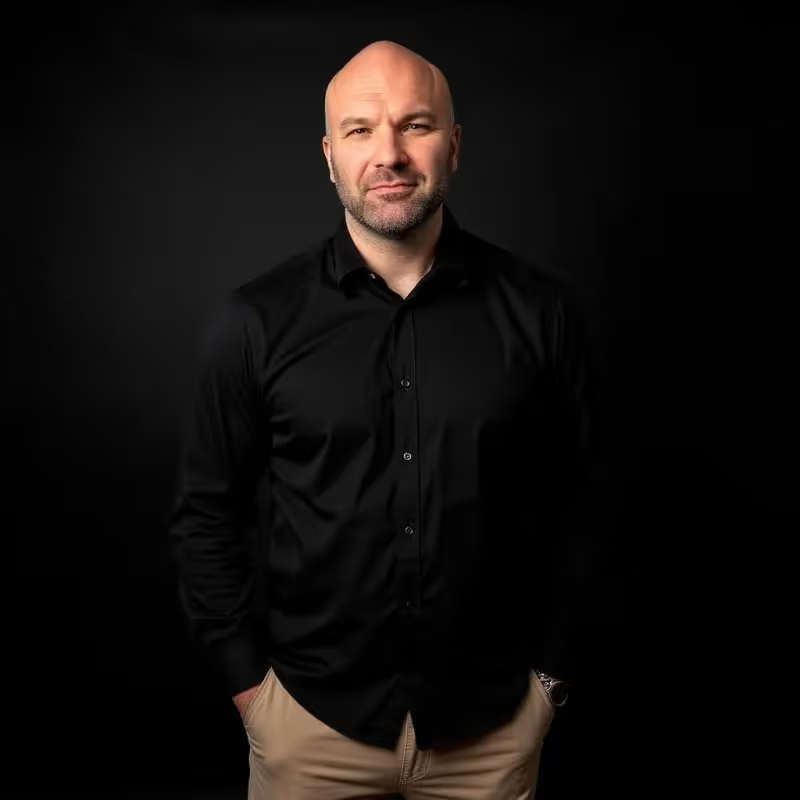
Mandy Hornaday: Hey Jonathan, welcome to the Growth Activated show today. We're so excited to have you.
Jonathan Kvarfordt: Man, and thanks for having me. It's so good to see you.
Mandy Hornaday: Yeah, you as well. So I know you go by Coach K. I've listened to your podcast. I've followed you on LinkedIn for a little while now. Why don't you give us a really quick overview on your background, where you're currently at today, what you're working on that's really firing you up.
Jonathan Kvarfordt: Yes.
Jonathan Kvarfordt: Well, you caught me in middle of flux because I'm not sure where I'm going to be going this next a while. But, you know, I'll give you my best shortest version. I started in my dad owned a tire mechanic shop, so I started sweeping floors when I was 10. And then I've been in the sales world since I was a teenager and then converted over to enablement. And for the last few years, we've been doing marketing. So a lot of what I do comes from being in the front end of of having to create.
Mandy Hornaday: Perfect.
Jonathan Kvarfordt: go to market motions from scratch and helping make sure the sales processes are running and all the stuff in the back end. I'm the person in the stuff in the back actually getting things done. That's me. And then this last I've been involved with AI for the last five years or so. So my my company I was with at the time bought an AI technology. This is before ChatGPT came out. And so the guy who literally built his own model is this brilliant guy in India came on as our as our chief AI guy.
Jonathan Kvarfordt: And my job was to make sure that the customers and the salespeople knew what the heck AI was and how it worked. And so I had to learn from him a ton of things, which I did. was awesome. And then when ChatGPT came out, as well as the other half of the world, the universe decided for ChatGPT. And I realized really quickly that people were using it not wrong, but just incomplete, I guess you could say. And I knew that because of my background in enablement and also my background with working with him, both an AI who I consider an AI expert.
Mandy Hornaday: Mmm.
Jonathan Kvarfordt: And so I began the Academy in December of 22 and have had 10,000 people plus go through the Academy last three years. I teach at Bryant University, AI 101 and AI in sales. I advise 10 different companies on either AI strategy or to market strategy. And currently, at least for the next month, I am the VP of go to market strategy and marketing for Momentum, which is a data agentic platform. So.
Mandy Hornaday: Yep. And, and which was recently acquired by Salesforce, right? And so that's, I imagine why. Okay. Interesting.
Jonathan Kvarfordt: We should acquire ourselves first. Yes. Yeah. That's why it's in flux is because I mean, there, yeah, there's some things happening that I sadly can't talk about in this time, but there's going to be some change in the next month. I just don't know what it is yet. So.
Mandy Hornaday: Yep. Awesome. Well, I am so excited to really break into some of, obviously you have a ton of exposure to what others are or aren't using AI for, especially as it relates to go to market and excited to dive into that. But before we go into that, Coach K, I would love to hear, it's always refreshing to me to hear other people's perspectives on what the true current state of AI and go to market is, because if you just follow LinkedIn, it sometimes feels like a shit show.
Mandy Hornaday: And so, and really overwhelming, right? And I sometimes wonder how much of it is close to reality. So I would love your perspective since you're in it, you're talking to so many different people. If you had to summarize where you think we truly are right now, what would you share?
Jonathan Kvarfordt: Yes.
Jonathan Kvarfordt: Well, I'll give you some actual data and so this is my opinion about that. So what I did with Momentum is that Momentum is a data company that bases off of conversations, emails, calls, etc. So we kind of kind of sort of like a Gong, but on steroids. And so I have all these data points. And we did this research paper where we talked about the first half of 25 and the last half of 25. And looking at what are the patterns of conversation around AI, because that's all we talked about all day long.
Mandy Hornaday: Perfect.
Jonathan Kvarfordt: And at the first of the year, and then you have to remember at 25 in April is when the Shopify memo came out to kind of, in my opinion, there's one of the things that started to accelerate a lot of AI budgets because everyone started to feel this pressure from the board level of adopting AI and getting efficiency and all this other stuff. So they weren't left behind. So the first half of 25, before that kind of happened, and then last half of April, it kicked in. Our data shows that only 7 % of people had actually operationalized AI.
Jonathan Kvarfordt: Now there's a difference though between operationalized AI inside your systems and processes, and then just throwing a Copilot or ChatGPT license to someone. So a lot of people have adopted AI with like a ChatGPT license, but that adoption does not equal transformation. It just means you've just thrown a license to someone who doesn't know how to prompt and doesn't know where to put it. It's just like, cool. I can write an email faster, but that doesn't give any revenue change in the business from writing the email faster. It's nice, but it's not making a huge difference.
Jonathan Kvarfordt: Now, the last half of the year, we saw that accelerate from 7 % to 25. So it's gone up by threefold, which is great, but still means 75 % of companies are still like way behind. So I know that LinkedIn and the market, like there's, there's this overall pressure that I, everyone I talk to feels that they're, they're behind and everyone else is ahead and there's, there's something wrong with them. I'm like, no, no, no, everyone's behind. And so are you, you know, it's like, we're all the same, but we're all trying to figure this stuff out.
Jonathan Kvarfordt: Now, I do think, that there are a handful of people who have done some what I consider the hard work in 25 who are accelerating fast in 26, but it's not the norm. They are the exception. So we chance. So I would say for people, this year is going to be the year that you have got to get things in order, because this year everyone else who's going to head is going to get so far ahead, it's going to be hard to catch up.
Mandy Hornaday: Yep, absolutely. I'm feeling that too. And it feels like even the start of 2026 is even more up going at a more accelerated pace than even the last half of 2025. So what, when you say like, you better get started and you better start building for it, where, what comes to mind in terms of where people should be starting to operationalize AI?
Jonathan Kvarfordt: Yeah. Yeah.
Jonathan Kvarfordt: depends on the size and depends on how much they want to blow things up. For an example, if you're a startup with like 50 people, obviously it's easier to change 50 people than it is to change 10,000. It's just obvious. So, but it can be done. I've seen enterprises do some major change. It just does require time and acquires investment, which I feel like a lot of people in this place of pressure, really saying we need transformation now, but we're not willing to do the hard work to get the transformation.
Mandy Hornaday: Okay.
Jonathan Kvarfordt: And they think that just throwing AI tech is going to solve the problem that doesn't do that. So I always tell people like there's three levels that you can start. OK, I'm going start with two different things. There's there's three levels of change and then there's two ways to do it. The one that on the one side you can do what you were doing before better, faster, easier, cheaper, et cetera. You can absolutely do that. The other side is thinking, what if we totally did something totally different, like way different? So the three ways to think about it is
Mandy Hornaday: Okay.
Jonathan Kvarfordt: You can start with optimization of time. Like there's so much wasted time all over the place that you can have some major ROI just from optimizing the time of your people and your processes and your customers on whatever's going on. The next level is amplification or augmentation. That's where you really look at, let's not just save time, but let's amplify what's happening so that it becomes a whole different experience because you're amplifying the human, not just optimizing the time.
Jonathan Kvarfordt: And then last version is total reinvention, transformation. But that does require that you shift everything. So let me give you an example. On the podcast, I had the Sendoso team, which was awesome. And by the way, they did this on their own. I'm going to use them as an example because they fit this model perfectly. They had 15 BDRs doing creating 15 % of pipeline. And they kept hearing about this AI stuff. And they said, Okay, we're going to blow this up. Now, please know, if BDRs were doing 90 % of pipeline, they probably would have not done this.
Jonathan Kvarfordt: but because it was only 15%, they had the ability to do this because it was less risky. Makes sense? So they pretty much let go of all their BDRs, kept one of them that was kind of playing with AI and said, let's redo the entire process and figure out where should the human really be that makes the biggest difference and how do we AI-ify everything else? So they had to define what do we want the human to do? What do we think is the most valuable time? And then how can we...
Jonathan Kvarfordt: optimize and amplify and reinvent everything. So they pretty much blew up the whole thing. Started from scratch. They figured out the process, the failure, the friction points, they figured out what was going wrong, which took again, this took about a month, month and a half from like when they stopped everything and kind of rebuilt. And then once they kind of figured it out, they added on one more BDR and another another one when three BDRs at month three, they were doing just as much pipeline with 15 BDRs with three.
Mandy Hornaday: you
Jonathan Kvarfordt: That makes sense. And then now they have, I think, four or five BDRs and they're doing 30 % of pipeline with four or five. So you have a third of the team doing twice as much pipeline. So make sense. But it required them to look at from the core, like what are we doing? And they know that at some point, they're gonna have to redo this again, but they're ready this time to do it faster. So if they have to do it again in a year because of AI capabilities, they can switch on a time, you know, but most teams are not set up or ready for that because
Jonathan Kvarfordt: it requires this hard look at what you're doing and what the customer experience is like and how can you make that better or faster or whatever? And then to adjust as you need to it takes commitment because this process I told you about was a six month process and they lost three months of pipeline build, but they caught up really quick. So that's I think that's where people need to realize is that it's like a slingshot. Like you're the rock in the slingshot. You're getting pulled back. You're going backwards. Like you feel like you're going the wrong way. But as soon as you let go, you
Jonathan Kvarfordt: out accelerate where you would have been before. So it's worth the time. just in the middle of it feels discouraging because you're like, I'm not going anywhere. So it's just you have to be patient with the process.
Mandy Hornaday: Yeah. Yeah.
Mandy Hornaday: Well, and that's a fascinating example because one of the things that is top of mind for me and to your point, to your earlier point of like a 50, you know, 50 person org is a lot easier to change and transform than a 10,000 org. But when I think about the marketing side and as a CMO, like what can I control and controlling my controllables, are you finding that in that instance, like did it, was it a company focused?
Mandy Hornaday: Commitment like where it was even outside of the SDR function that they had to be focused and in on this Or is it something that the SDR function and the sales leader or the chief revenue officer or whoever it was was able to Run this within their own department because I think that's what I you know I work in larger organizations as a CMO and so what I'm trying to figure out the balance is like what can I control within my organization and transform
Jonathan Kvarfordt: Yeah. Yeah.
Jonathan Kvarfordt: Mm-hmm.
Mandy Hornaday: even if the broader organization isn't operating at that speed of transformation. Right.
Jonathan Kvarfordt: Yeah, this particular instance is coming from top down like the I had the podcast, the CEO is on with us because he's like, I want to be here and I want to talk about this, you know, and of course Sendoso, I mean, they're not small, but they're also not huge, you know, so it's like they're a mid market company. It's not the same when you have like I've been talking to the CMO of Agentforce at Salesforce, they have a massive worry with a lot behind them. So it's a totally different world to be able to do this. However, I do think it's possible. It's not that you're
Mandy Hornaday: Mm.
Jonathan Kvarfordt: incapable of doing this. It just depends on how much, how much you're able to blow up what's going on. And that is determined by the leadership because some leaders in massive orgs are blowing things up and others are going a little bit slower and everyone has to do what they think is best for their business. You know, I'm not here to judge and say blow everything up. I don't think that's always the answer. It's really depends on where you're at in your system. So for you, if, if you or anybody else listening as a CMO of a large org,
Jonathan Kvarfordt: and you don't think you can make those dramatic changes. If all you did was optimize, if that's all you did, look at how can we save time? You'd be surprised of how much more you can do with just that. Does that make sense? But it does require you to slow down and get past the whirlwind of everyday shenanigans and look at the first principles job to be done type thinking around what are we doing and what are we trying to accomplish? Because in my opinion, like with marketing,
Jonathan Kvarfordt: You're not going to replace a CMO's ability to to strategize and to think about like I can do an amazing job of analyzing the data and bringing up ideas of what works and what channel and most of the stuff does a great job. But when I have a crazy idea or I have a an idea of how to create. Brand demand generation. I obviously talked to the I thought, but that came from my brain, like the best ideas come in the shower. They don't come with a I so I guess.
Mandy Hornaday: Yeah.
Jonathan Kvarfordt: But I use AI to either think through the process and make sure I'm not missing anything or to then actually execute on the plan. it's just, and I don't think that AI could never get there. I just think that there is still this unique creativity, human genius part of it that is unique and not that in AI couldn't replace it. I just think it's going to be a difference between AI generated strategy and then a specialist experienced marketing leader in strategy. That makes sense?
Mandy Hornaday: Yeah. Yeah. Yeah. No, absolutely. Absolutely. And in a lot of ways, I mean, one of my areas of sort of expertise and specialization is an operational excellence and really, really building and, you know, I just agile operating systems. And I think AI, if anything, making that, making it, amplifying the problems that we've always had in marketing that if you, if you haven't solved through those things, like you're just making the problems worse.
Jonathan Kvarfordt: Yes.
Mandy Hornaday: I'm just adding fuel to the fire for sure.
Jonathan Kvarfordt: Yes. Yep. Yeah, it's funny how AI is forcing people both on an individual basis and an organizational basis to really look at the problems they've never had to look at before. It's like when people have problems in their sales process, they could get by because it's such great demand for the product that he just kind of skipped over and glazed over it. But now they have to look at the skeletons. You have to look at it because I will will amplify the skeletons and you don't want to do that.
Mandy Hornaday: Yep. Yep. So, hey, I'd love to hear the Sendoso example is such a cool use case. I'll go check out that podcast. What are some of your favorite use cases you're seeing within marketing right now that you think are really powerful?
Jonathan Kvarfordt: man, there's so much cool stuff right now. So much more stuff. Yeah. I personally like the ability like one thing I love about A.I. is its conversion thinking ability of a lot of different data. So the world we exist in where you can take all this information from larger market trends and third party signals to advertising data from like a.
Mandy Hornaday: Mm-hmm.
Jonathan Kvarfordt: whatever source you want to talk about from Vector, Demandbase, whatever. And then look at all of your own advertising data from Facebook and TikTok and Twitter. Then you take your social media data of just like regular organic data. And then you look at the market as a whole and 401k is like all this stuff. The fact that we can have an AI that can consume all of that, put bit put together patterns and give us things that I can build myself is insanity. It's crazy. I love it.
Jonathan Kvarfordt: So that's some of the coolest thing I'm seeing in marketing is when someone's able to digest all that information and some create some really cool things as a result is awesome. I also think AI is a really good mimicker. So like when I see something working in a different industry way, I always watch marketers because there's a marketer in healthcare. I would my like crazy. I think they won't ever want to come to tech.
Jonathan Kvarfordt: which is probably good because I wouldn't have a job because they're awesome. But they inspire me so much that I just want to follow her strategy around what she does, the branding, those stuff. So I watched those kinds of things. I can use AI and say, go look at this company and help me apply it to mine and tell me what I can do. Like that kind of thing is awesome. And then besides that, it's like some basic simple automations, like to your point, operationally, there's a lot of things AI can do that most people aren't doing. I think they should be doing to help the process from
Jonathan Kvarfordt: Again, identifying what is the content you should be making to make the biggest impact or what channels would be performing the best or where the ICP is and what the message should be and automating that process. Like there's so many cool things you can do. However, I also say that a lot of the most impactful things we did at Momentum, AI absolutely amplified it, but they never would have come from an AI idea. And trust me, I know because I asked a lot. It was just, it was just what I'm finding is a pattern is that the more
Mandy Hornaday: You
Jonathan Kvarfordt: human based things I can do, the more I focus on the human, the more success I had. So it's like, for example, we did a lot with AI optimization is a ton of stuff you can do. But the best things I did was when I focused on where's the human ICP at? And how do I optimize to make sure I get a surround sound around that person, whoever that is. And I use whatever means I needed to do that. And then I focus on how much
Jonathan Kvarfordt: How much can I give value to the human so that they trust me as a brand? Which AI absolutely helped me create that. But that value is something that I had to think of because I'm the ICP. Does that make sense? Because AI will give you the generalized version of what the ICP will care about. But I know it because I talk to people all the time and AI could probably do it for me. But a lot of times I think that instinct, that gut feel is just as important now as it was before. And I'm a big data person. Please don't want to say that.
Jonathan Kvarfordt: I'd rather rely on data, but I still have this instinct that I'm going to go with this because I feel like this is what humans care about. know? So I don't know if that helps at all.
Mandy Hornaday: Yeah, yeah.
Mandy Hornaday: Yep, Totally. Well, and one of the first things that you were mentioning around sort of the research and the synthesis, synthesization, I guess, of large amounts of information, I myself find that really fascinating. It's been, I feel like I'm able to learn at a faster speed than probably ever before. Where I see a lot of people, I guess, falling short and or
Mandy Hornaday: not following through on is like the activation of that information. Like it's one thing to like know all these things about your competitor and get it delivered to a Slack channel, you know, weekly or whatever it is. but I'm curious, like, do you, are you also seeing that? Cause to me, it's almost like information overload. we're creating it's like, yes, you can have access to all these amazing insights and information, but what the heck are you going to do with it? And is it, is it just overwhelming you in the end?
Jonathan Kvarfordt: Yes.
Jonathan Kvarfordt: Yeah, yeah.
Jonathan Kvarfordt: It's a good point and it's very easy to get overwhelmed with flutery anybody and anything with AI because it's just a however, I do think this year's the year where that's going to transition because have you been following OpenClaw at all?
Mandy Hornaday: Yeah, here and there. Yeah.
Jonathan Kvarfordt: Little bit. Okay. It's, I've been deep in it and not, not, mean, I can't use it on my work computer, obviously, but I've been testing it out and doing some things with perplexity computer. Like the things that are able to do now is moving from the analysis stage to the analysis slash execution stage. I can actually get crap done, you know? and I bring up OpenClaw because as an example, when you have an AI that is connected to all of your different systems and that can do the analysis and then understand, okay,
Jonathan Kvarfordt: I'm seeing that TikTok has this thing and then automatically creates this automation that creates a UGC type video around your product automatically and then post it automatically. That is actually getting the stuff done. And then it looks at that video's performance comes back to the original agent and optimizes it. Does it again, and kids get to use this loop of just optimizing the content like that is happening right now. People are doing that and they're having success doing it. It's crazy. Um, so there's, but that does require
Jonathan Kvarfordt: in infrastructure and marketing, and also a trust in AI that most people don't have. And to be fair, like, I would tell anybody listening, if you are not an expert in AI and don't know you're doing do not do OpenClaw because there's a lot of security things you need to be aware of first. But that concept is is what's showing us where we're going. So in a sense, so like perplexity computer just launched three or four days ago, it can do what OpenClaw can do. And it's a safer version. So like, it's coming to market.
Jonathan Kvarfordt: So the real question is going to be, I think, for marketers understanding. I'll give you one more experience. I'm sorry. Let me, I don't want to get side to a segue, but Google came out with WebMCP. And that is because they said the internet was not built for AI agents. It was built for humans. And so we're forcing AI to go through a searching function that humans do. And that's the wrong way to do it. So the recreating the guts of the internet to make sure it's friendly for AI.
Mandy Hornaday: No, no.
Jonathan Kvarfordt: A banking system just, you they said the same thing. The banking system was set up for humans. It wasn't set up for AI agents. So they're thinking about a different protocol for banking to be able work, which is through the blockchain and some other stuff. So there's this whole world where anything that was built was for humans. You've got to rethink how things go. And as a marketer, have to think about how do I market to the AI and how do I market to the human? Like it's no longer just one way. It's not, it's not just saying
Jonathan Kvarfordt: I want to market to the human using a search is marketing to an agent. There's no human involved. So that's so that's where you got to be thinking about it. And that's why I think some really, really cool things can happen. But that means a lot of your trust and control will go to an AI doing things. It depends on how comfortable you are with letting that happen.
Mandy Hornaday: Yeah.
Mandy Hornaday: Yep. Well, and I think what's interesting and to your point earlier about like you're using OpenClaw, but not necessarily through work for your personal. I actually just saw this really interesting LinkedIn post that gave me pause a week or two ago. And it was talking about how marketing leaders that are working for very AI forward companies who give them more room to explore and experiment will have like a 10 X advantage over the ones who are in corporate environments where
Jonathan Kvarfordt: Nothing much. Yeah.
Jonathan Kvarfordt: Yeah.
Mandy Hornaday: They've got a lot of restrictions. Yeah. I'm curious. I'm curious whether you're seeing that and, and what you would advise to the CMOs and marketing leaders who are in those really tight security driven organizations, like how can they make sure they're staying cutting edge on some of this stuff?
Jonathan Kvarfordt: The cats. Yes.
Jonathan Kvarfordt: I would say to be aware, but I'm a big security nuts because I am for work I have to be, but also because I think it's important to be concerned about it, at least aware. So if I was someone in a massive org, I would absolutely deep dive into the possibilities and then be patient because as more secure version will come, the question will be, will you be ready for it? So I would say get ready because it's Like for example, I'll use, I'll use
Jonathan Kvarfordt: Salesforce is an example. I don't have the budget or the distribution that Salesforce has. They have a partner program, they have marketing volume, they have 150,000 plus customers. Like it's Salesforce. It'd be really hard for me to compete. The only way I can compete is using AI to my advantage. In fact, I know because I have some tracking on the terms that Momentum does before we were acquired, I was ranking way higher than Salesforce was and it's freaking Salesforce that I'm competing against. So makes sense. So there is a way to beat the big boys if you're small.
Jonathan Kvarfordt: But at same time, the big boys have the things that I don't have, you know? So it's like, I don't think they're lost and they're going to be destroyed. It's just that they have a larger ship to shift. And like you said, a lot of secure things they have to kind of wait for. So they kind of have their hands tied a little bit. But that's why I think I start with optimization saying you can optimize your team. There are SOC 2 secure different platforms. You can absolutely do some automations in it. Like one's MindStudio, mindstudio.ai. I'm a master for them.
Jonathan Kvarfordt: They're amazing. And you can absolutely do a ton of really cool automation things in marketing right now and SOC 2 secure and would be fitting for anything in security. So there is things out there. Is it OpenClaw level yet? No, but we'll get there. Yes. So it's just a matter of getting your hands dirty. It may not be like, if you're here, and MindStudio is here and OpenClaw is here, get here, get as far as you can. Versus just run it out of the way of OpenClaw. Like it's not it's you're going to be hurting in the next year or two if you don't do that.
Mandy Hornaday: Mm.
Mandy Hornaday: Yeah, yeah, no, that's a great point. And a great reminder that it's changing so fast and new things are coming all the time. yeah, yeah. Any other tools besides MindStudio that you would, you'd recommend, you think they're really powerful?
Jonathan Kvarfordt: All the time.
Jonathan Kvarfordt: I'm a big AI search and I've been geeking out on it. So there's a, there's a couple that people would consider. I'm sure people have heard of Profound. Profound is a great tech. I'm a big fan of Searchable. Searchable.com, which is great. And then the other one is Peec, and both of them, think are really, really cool. I like, I lean towards Searchable just a little bit, but they're both really good techs from an AI search optimization point of view. And then I do like.
Mandy Hornaday: Okay.
Jonathan Kvarfordt: Like there's just general automation orchestration platforms. like foreign marketing, like a MindStudio or using like right now I'm in geeking out to Claude. Like there's so many cool things to with Claude Code right now. It's like kind of blowing my mind to where it's the more people get MCP connections and integrations. It's taking me away from other tech that would be like a Zapier. It's taking me away from most because I can build things customized for me and say, here's like the other day I just took a bunch of marketers through
Jonathan Kvarfordt: how to do an analysis on all the different data points you have in Claude Cowork and to create a brand deck that you could present to your board within the half hour, which I do. Words have taken me weeks before, you know, it's just like, I don't think people understand just optimizing. When you look at that consequence of like what took me weeks before has taken me two hours. That speed you compound that over time, I'm gonna be blown out of the water. Anybody even close to me because they can keep up with me, you know? So anyways.
Mandy Hornaday: Yep. Yep.
Jonathan Kvarfordt: I would say if you're a marketer right now, you should absolutely be looking into Claude in some level, or at least what's called skills. The skills concept is like where I think things are going. OpenClaw was built on skills. So if you don't understand what skills is, go into YouTube, learn for free. There's a ton of cool stuff out there for free. And start geeking out to it because it's where it's going to be unlocking a ton of really cool stuff.
Mandy Hornaday: Yeah, absolutely. Well, that was such a great, I know we're coming to a close here and such a great note, because one of my closing questions was going to be, where would you encourage people to start? And is learning skills one of the big things you would say, or are there other areas that you would really focus CMOs and marketing leaders on?
Jonathan Kvarfordt: Yeah.
Jonathan Kvarfordt: That's a question. Well, there's a ton of really, really good people like you're obviously one of them talk about this. So obviously we'll see you. But I think what I'm seeing in the market is that people who have technology are putting out really good free education on YouTube just to get people to the technology. So I would say lean on YouTube. There's a ton of really cool stuff there that is like really good, meaty stuff.
Jonathan Kvarfordt: and then just be willing to experiment and do it. And obviously in the less risky, safe way. Cause again, if somebody listening or massive enterprises, you only have a little bit of room, but I would say push it, like try it and see what you can break in the less risky way. And then you asked another part of the question. Sorry, what was the last thing you asked? Sorry.
Mandy Hornaday: No, I think you covered it, just in terms of where to start. And I agree, actually, one of the things that's been really cool for me is I'm a fractional CMO at a few different organizations. so I have my own business. And so I find myself doing a lot of fun experimentation on my own business that then I can take and apply, as it makes sense, back to the organization.
Jonathan Kvarfordt: Yeah.
Jonathan Kvarfordt: Yeah, yeah, yeah. It's fun.
Jonathan Kvarfordt: Yeah, I would say as a concept skills for sure should be one you look at only because it's kind of like how you make a multi-agent framework using skills, which is again what OpenClaw was built on. The more someone can understand the basics of that and the consequences of what it will do in a good way, the more it's going to open up your thinking around what you can do with just as a marketing leader. Like it's pretty crazy. So and then besides that, it's more about thinking.
Mandy Hornaday: Yeah. Yeah.
Jonathan Kvarfordt: That's the A.I. The other side is fundamentals. Like I can't say how much the fundamentals are just as is not more important now more than ever. And that allows one more thing, which is whatever your genius is, I think is going to be part of not the but part of the moat that you will bring to a company, because even when A.I. smarter than us, which it is, and even when it can do everything we can do, which you can, it cannot replace the human genius inside of you with your experience and your
Jonathan Kvarfordt: all this other stuff because you're going to have your own soul based tech.
Jonathan Kvarfordt: Spark genius, we want to call it. The AI will never ever replace this because this is not going to do it. It has to be another entity. It'll be better, faster, easier and smarter than you. But we'll not have that genius. And so I would say whatever geeks you out about marketing, dive in and really, really get good at and give yourself the chance to really get just passionate about it. That's what I would say. Your passion will be your moat.
Mandy Hornaday: Yeah.
Mandy Hornaday: Yeah, yeah, completely agree. Awesome. Well, so fun to have you here today, Jonathan. Thank you so much. I know obviously people can find you on LinkedIn, you run a podcast. Why don't you just quickly run through where you would direct people to keep learning from you.
Jonathan Kvarfordt: Thank you.
Jonathan Kvarfordt: Yeah, just I would say LinkedIn is the easiest place to go to. And then if they go to the GTM AI Podcast, that's where a lot of the dumping ground of stuff like all the all things go to market. So that in my LinkedIn, I just I consider it my GTM AI journal. So I just post stuff there. It's just kind of fun. Yeah.
Mandy Hornaday: I love it. love it. Well, thank you so much. It was such a pleasure. We'll have to catch up again soon.
Jonathan Kvarfordt: Thank you so much, Mandy